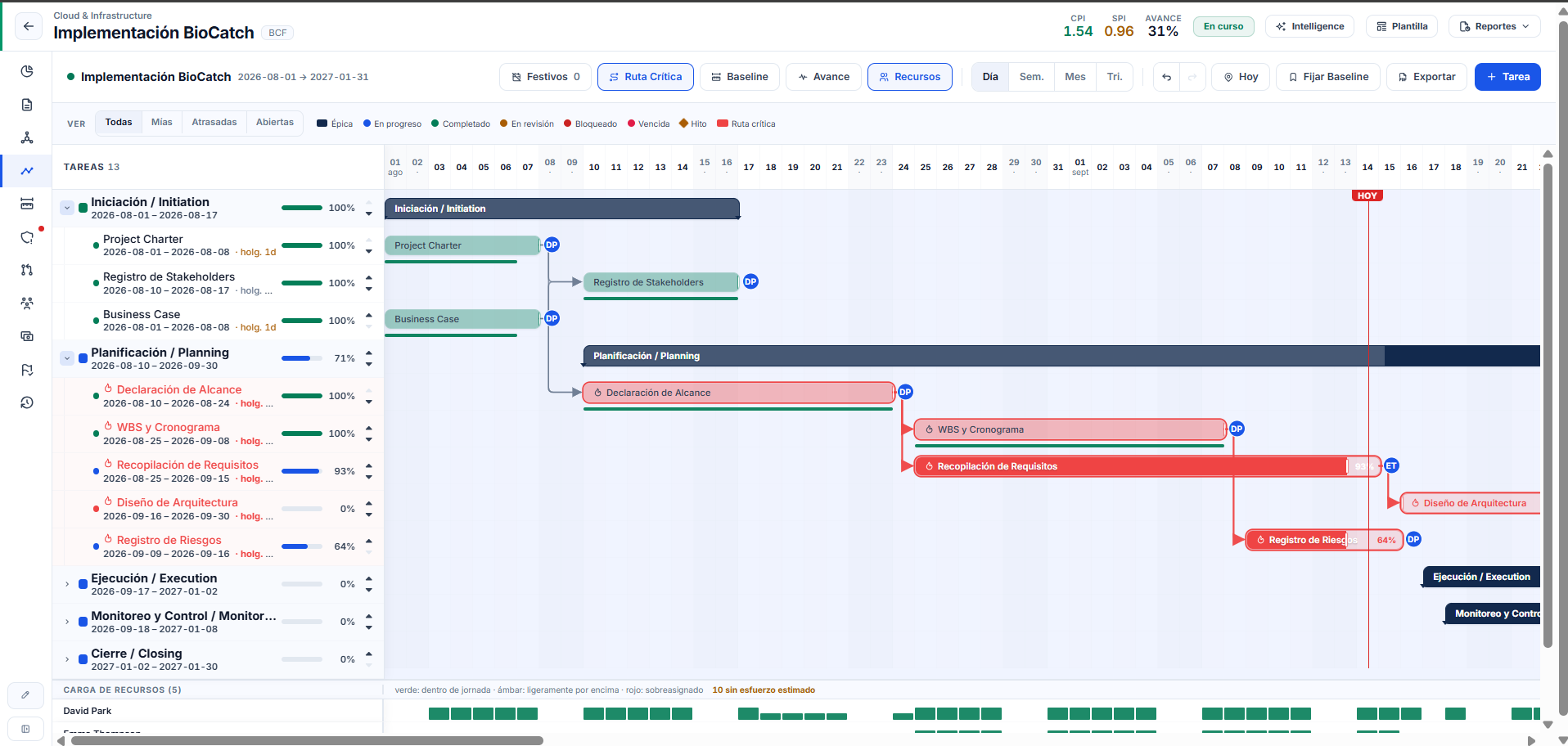
It spots the drift and proposes the fix. You confirm.
It is not a chat that answers questions. It watches your portfolio with earned-value rules, flags what is going wrong, and proposes the concrete action: create the risk, log the change, adjust the date, set the stage. You confirm, it executes.
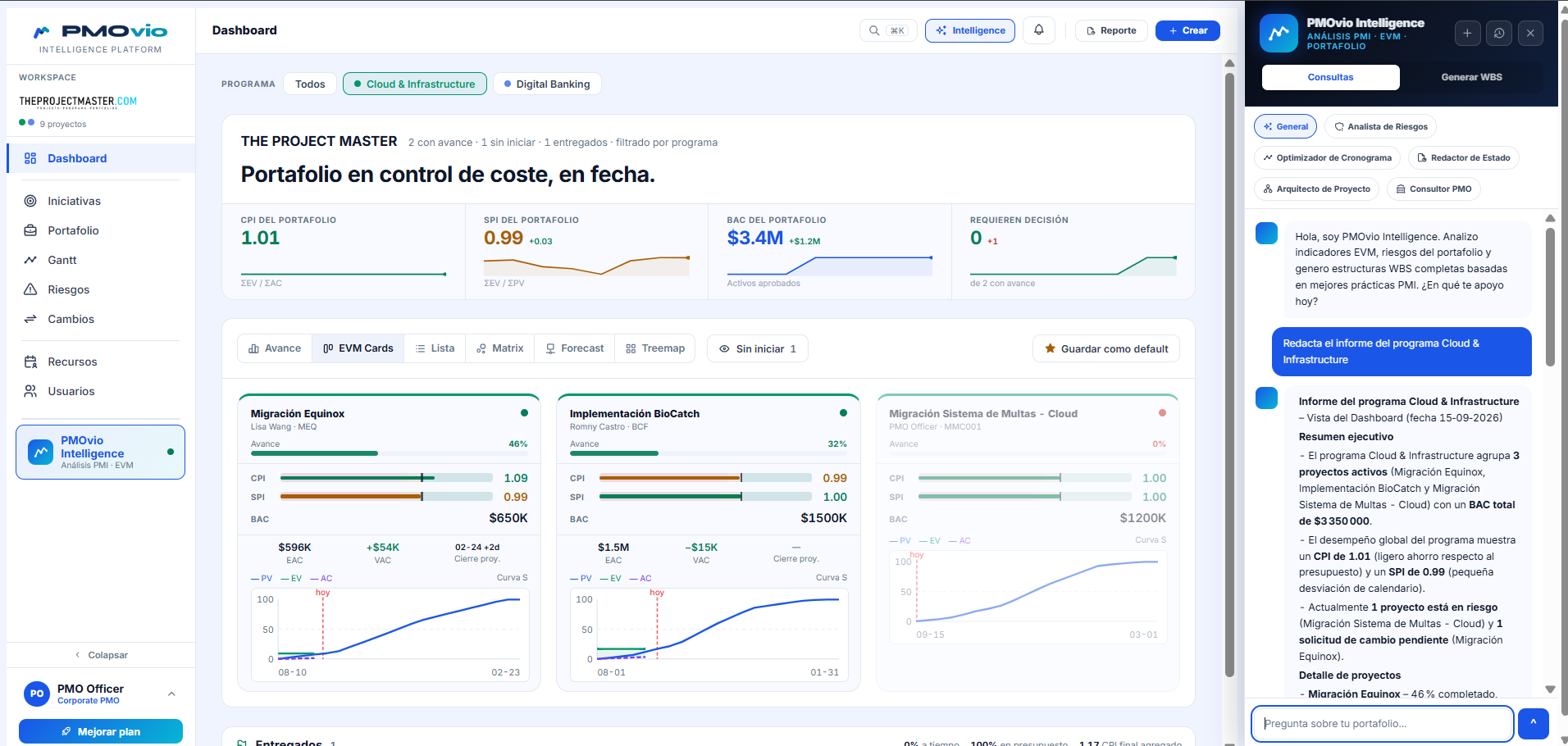
The number your committee asks for.
Computed for you.
CPI, SPI, CV, SV, EAC, ETC, VAC and TCPI are computed from progress and cost. The health status comes from PMBOK, not from whoever is reporting.
And you know it weeks before the finish, not at the finish.
The Predictive Dashboard projects the finish date and final cost with an optimistic–pessimistic band from your portfolio's real history. And it keeps your track record: % on time, % on budget, average final CPI.
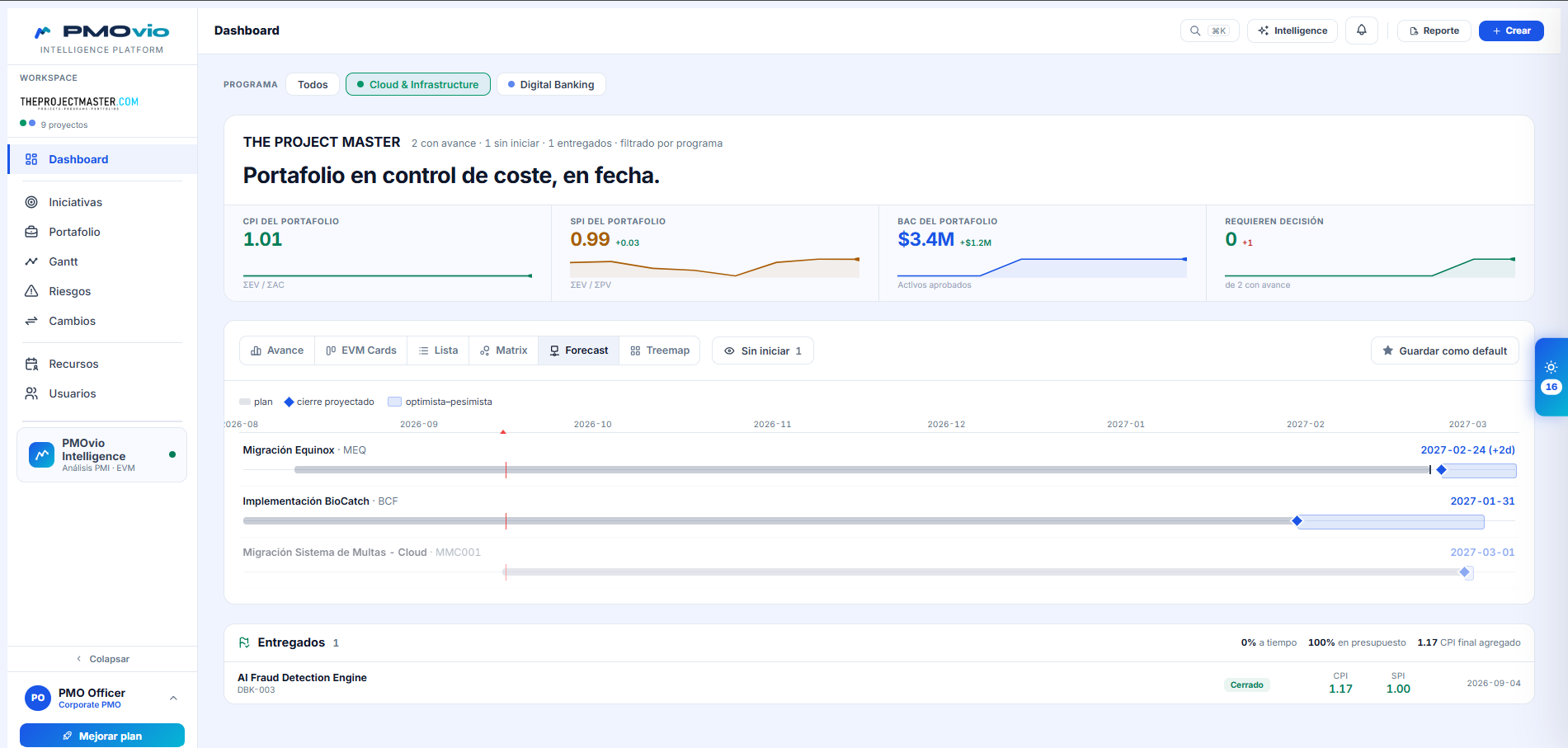
Everyone starts the day knowing what is on their plate.
My Day is not another portfolio panel: it is yours. A written summary of which project to handle first and why, the decisions waiting for your approval and the open high risks. And your hours for the week, in the same place.
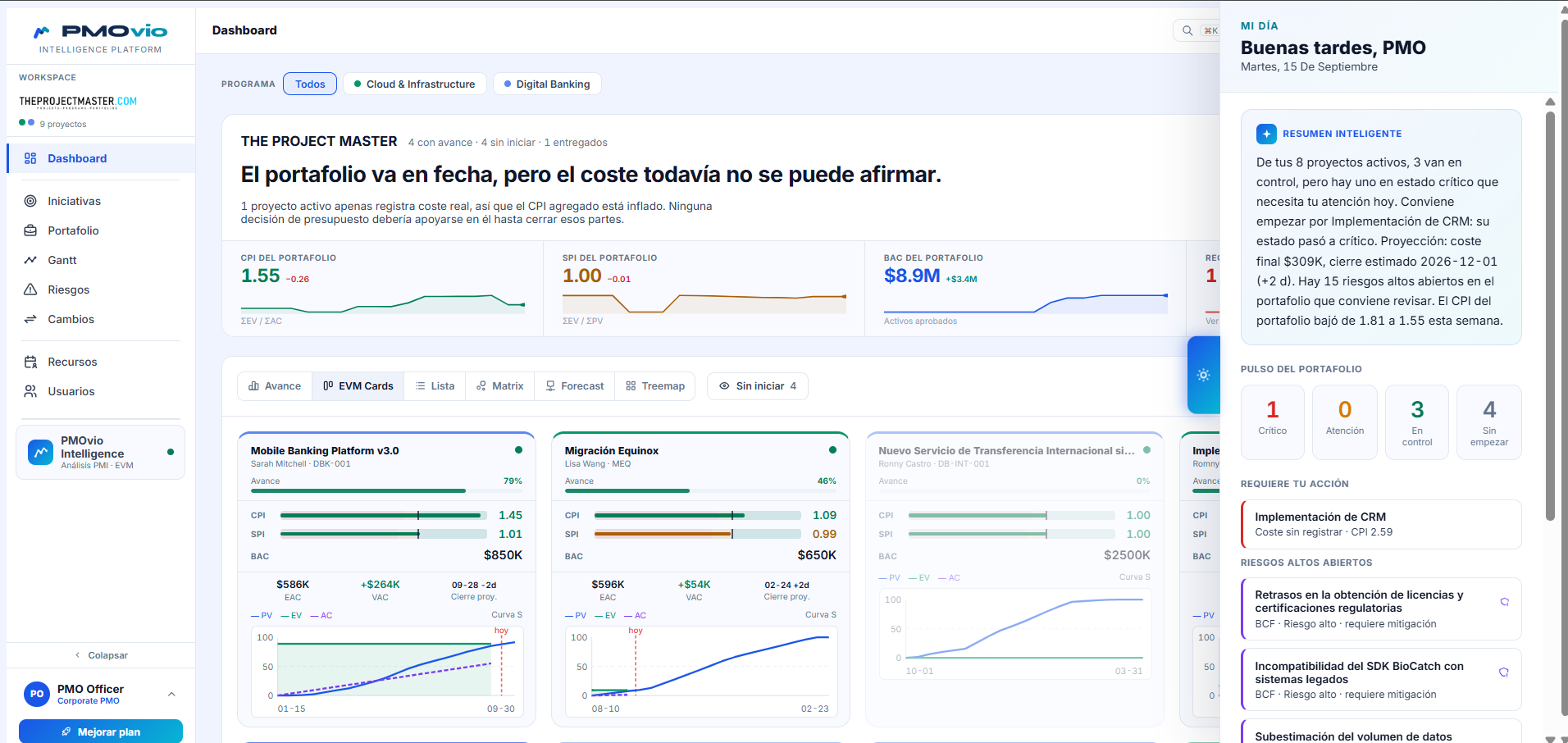
And the schedule is still yours, not a PDF you look at.
Drag bars to move or resize, drag the handle for progress, and dependents reschedule themselves. FS/SS/FF/SF dependencies with lag, critical path by float, baseline shadow and undo/redo.
Your task tool isn't lying.
It just doesn't know.
Task tools (Monday, ClickUp, Asana)
- Progress = sum of tasks marked done
- Status is set by whoever reports
- Cost lives in another spreadsheet
- General-purpose AI, billed separately
- No formal change control or earned value
- No initiative funnel or committee gate
PMOvio
- Progress = earned value (EV) against plan and actual cost
- The status is computed by PMBOK, automatically
- Budget, purchase orders and resource cost integrated with EV
- Specialist PMO agent, included in every plan
- Risk register with matrix + integrated change control (CCR)
- Scored initiatives → committee gate → conversion to a project
Many teams use both: one to coordinate daily work, PMOvio to govern the portfolio.
Ready for your client's security review
Built for regulated industries: banking, payments, healthcare, public sector.
Data in the EU
Infrastructure located in Ireland, within the European Union. GDPR-compliant processing, detailed in the privacy policy.
Per-organization isolation
Row-level security (RLS): no company can see another company's data. Partners manage accounts, not project content.
Pseudonymized AI
The AI receives performance metrics labelled P1, P2… — no client names, no personal data, no document contents. Providers do not train on this data.
AI can be turned off
Each organization can fully switch off the AI feature from its admin panel or its PMOvio partner's. If the client requires it, it's off.
From initiative to closure, every PMBOK process covered
Smart Daily Brief
On login, each user sees what needs attention for their role: portfolio pulse, pending approvals and priorities.
Initiatives · demand management
Before it becomes a project: business case, weighted scoring, value × effort frontier and a committee gate. Once approved, it converts to a project with the BAC and scope from the case.
Budget & Procurement
Time-phased cost baseline and S-curve (planned / committed / actual), EAC per line item, suppliers with PO approval and invoicing, contingency and management reserve, and a cash-flow disbursement schedule.
Risks + Change Control
Register with exposure matrix, CCR with approval workflow and cost/schedule impact.
Teamwork, live
Two people edit the same project at once without stepping on each other: changes are merged field by field, and it only asks when you both touched the same value. You see who is in the project and who has the task open, and History records who changed what and when. Plus task comments with @mentions and an alert bell with context.
Resources & Capacity
Time axis with real capacity, demand-vs-capacity heatmap, skills matrix with levels, generic roles, tentative bookings and a timesheet that feeds actual cost and EVM.
Committee report
Generated for you: an AI-written headline, indicators with trend and portfolio EAC, and the decisions the committee needs to make —derived from the EVM rules— with a recommendation. Exportable to PDF, bilingual.
Built by someone who
has sat in your chair
I spent two decades leading transformation programs in banking, payments and regulated industries, across Europe and Latin America. And I kept running into the same thing: the steering committee would meet, and the progress we reported was an estimate nobody could defend with data.
The tools out there organize tasks, but they do not answer the question that matters: is this project actually on track? That takes earned value, change control and PMI discipline. That is PMOvio.
If you run a PMO and want to see it working, write to me. I run the demos myself.
Simple and transparent
15-day trial, no card. Per user/month, billed annually (save 2 months).
What people usually ask
How is it different from Monday, ClickUp or Asana?
Those tools organize team work, and they do it well. PMOvio answers a different question: whether the project is actually on track. It computes earned value (CPI, SPI), forecasts the finish (EAC, VAC), manages risks with an exposure matrix and runs integrated change control under PMI standards. Many teams use both.
What is earned value and why should I care?
Earned value (EVM) compares what has been produced against what has been spent and what was planned. CPI tells you whether money is performing, SPI whether the schedule holds. A project reported at 70% with a CPI of 0.87 is burning budget faster than it delivers. That figure does not show up on a task board, and it is exactly what a steering committee needs.
Does the AI cost extra?
No. It is included in every plan, with no credits to buy and no add-ons to enable. Other platforms charge for AI separately, between 9 and 28 dollars per user per month, metered by usage. Here the price you see is the price you pay.
How is our data protected in the AI feature?
The AI receives pseudonymized performance metrics: projects travel as P1, P2…, with no client names, no personal data, no document contents. Your message is also pseudonymized and the answer is rehydrated to real names only on your screen. Each organization can fully disable the AI from its panel or its partner's. AI providers do not train on commercial-API data.
Where is our data stored?
On infrastructure located in Ireland, within the European Union, with per-organization isolation: no company can see another company's data. Processing is governed by GDPR and detailed in our privacy policy.
How long does it take to get started?
Creating an account and loading your first project takes minutes. Nothing to install, no consulting required. What does take time is discipline: for the indicators to mean anything, progress and cost data must be kept current. That part depends on the team, not the tool.
Does it work if we use agile?
Today PMOvio is oriented to predictive and hybrid management: schedule, baseline, earned value and change control. If your operation is purely agile with sprints and backlog, there are better-fitting tools. Support for hybrid and agile environments is on our product roadmap, but we prefer to say so plainly rather than overpromise.
Is there a lock-in or cancellation fee?
There is no lock-in. You can cancel at any time and keep access until the end of the period you paid for. Annual plans are billed upfront and are non-refundable, which is standard practice in software subscriptions.
What if the team grows?
You pay for seats, not people. If someone leaves, another person takes their seat at no extra cost. You are only charged when you need more seats than contracted, prorated for the remaining months of the period.
Another question? Write to us at ceo@theprojectmaster.com